
Tolland County Arrest News Sources
Where does Tolland County arrest news start? For most people, with CSP News. Connecticut State Police publish selected high-interest incidents there, and a dated RSS feed carries short summaries of each. Try searching for Troop C or a Tolland town name. A useful release may surface. But the stream is partial by design. State Police policy limits online posts to major or high-interest events. Quieter troop releases may exist only at the troop itself.
Local departments patch things together differently. Vernon Police posts selected press releases and points readers to social media for faster items. Mansfield leans on resident state troopers off campus. UConn Police covers Storrs and publishes a crime log. Ellington keeps resident troopers but no municipal arrest log or booking feed. Even combined, that's no complete Tolland County roster. Someone released by police might never appear in the DOC inmate search. Start with the official CSP release stream, and remember that silence about an event doesn't mean no arrest happened.
Tolland County Arrest News Outlets
Tolland County's news mix pairs official agency publishing with two established outlets, campus records, and a scattering of secondary database pages. No dedicated county TV or radio arrest feed exists. Nothing here is invented to fill the gap. Official sources lead the table.
| Outlet | Coverage | Photos? | Where |
|---|---|---|---|
| CSP News | Selected statewide incidents, searchable for Troop C and local towns | Sometimes, as supplied with a release | Official web and RSS stream |
| Vernon Police | Selected local releases with no fixed comprehensive cadence | May vary by release | Official press-release page |
| UConn Police | Daily print and weekly electronic Storrs incident log | No mugshots in the log | Official crime log |
| Patch Tolland | Periodic Troop C roundups and event-driven stories | Selective police, scene, stock, or contributed images | Crime & Safety section |
| Journal Inquirer / CT Insider | Near-daily general local news with event-driven Vernon crime and court reports | Selective scene, stock, contributed, or accused-person images | Vernon coverage |
| Recently Booked | Unofficial Tolland-labeled last-30-day list seen during research | Image areas, with current placeholders observed | Secondary discovery source, not proof of custody or outcome |
| Mugshots.com | Unofficial county shell with no live items observed | No current local set established | Secondary county node, not demonstrated as current coverage |
Some secondary sites create more confusion than help. Recently Booked leans on generic sheriff and county-jail wording, even though Tolland County has neither. The Mugshots.com county node came up empty. That is why facility claims, dates, and charges on secondary pages deserve checking against police, Judicial, and DOC records. Busted Newspaper, Arrests.org, and Mugshots.zone showed no verifiable Tolland-local page, and guessed links are not coverage.
Tolland Arrest Photos Reach News
Where does a news photo actually come from? Any of several places. It might be an agency release, a records request, a scene photographer, stock art, or another credited source. Connecticut sets no uniform commercial mugshot schedule by statute. Access rests on the state public-record framework instead. That includes CGS sections 1-210, 1-212, and 1-215, with exemptions, erasure, and confidentiality rules layered on top.
Agencies vary here. One may attach a booking photo to a selected release. Or publish nothing at all. DOC Directive 4.4 lists an inmate photo among information releasable for a current offender. That applies only after DOC admission, though. It doesn't promise an image on every online profile. Plenty of people released by police never reach DOC custody. News outlets simply can't produce a mugshot for every arrest they report.
- Booking photo
- An identification image created during processing if the agency makes and maintains one.
- Arraignment
- The first court appearance, where the case begins its public court stage.
- Disposition
- The court outcome, such as conviction, dismissal, acquittal, or another final result.
One more point about any published photo. It freezes a single moment and reveals nothing about how the charge later changed. The final court record holds that answer.
Follow Tolland County Arrest Records
Work from the article back to the office that created each record. Tolland County has no sheriff roster serving as a universal bridge. Your path depends on the arresting agency. It also depends on where the person ended up.
- Read the story's date, town, arresting agency, name spelling, and any incident or docket number. Then open the cited police release if one is linked.
- Ask the arresting department for the arrest record and photo, if created and maintained. Troop C and resident-trooper reports use the DESPP records route; Vernon and UConn keep their own request paths.
- Check Connecticut Judicial Pending Case and Daily Docket after the normal business-day update. A same-day event may not appear yet.
- Use the CT DOC locator only if remand into state custody is plausible. An “Accused” status means pretrial custody, while “Sentenced” reflects a later custody state.
- Return to Judicial Convictions, the clerk, or the Records Center for the disposition. The original news charge does not establish the outcome.
The Tolland County records hub maps the full routes through agencies, courts, custody, and records requests. It also explains why released, remanded, and sentenced people land in different systems. That distinction matters. A missing DOC result should never be read as proof that no police report or court case exists.
Tolland County News Blotter Patterns
Patch keeps an active Tolland Crime & Safety stream. Its periodic "Troop C Log" roundups come from State Police arrest reports, though the rhythm isn't reliably weekly. Individual Patch stories also draw on warrants and Judicial records. Images run the full range. Expect scene pictures, stock art, and generic police shots. Some incident stories include a CSP-supplied image of an accused person.
Journal Inquirer works differently. It's now carried through CT Insider. Its Vernon page delivers broad local reporting on a daily or near-daily rhythm, with crime stories appearing as events warrant. Those pieces commonly cite Vernon Police statements or social posts, State Police reports, warrants, and court files. It is not a booking roster. Nor does it promise a mugshot with each story. The Patch Tolland Crime and Safety section shows this recurring but unofficial news stream in action.
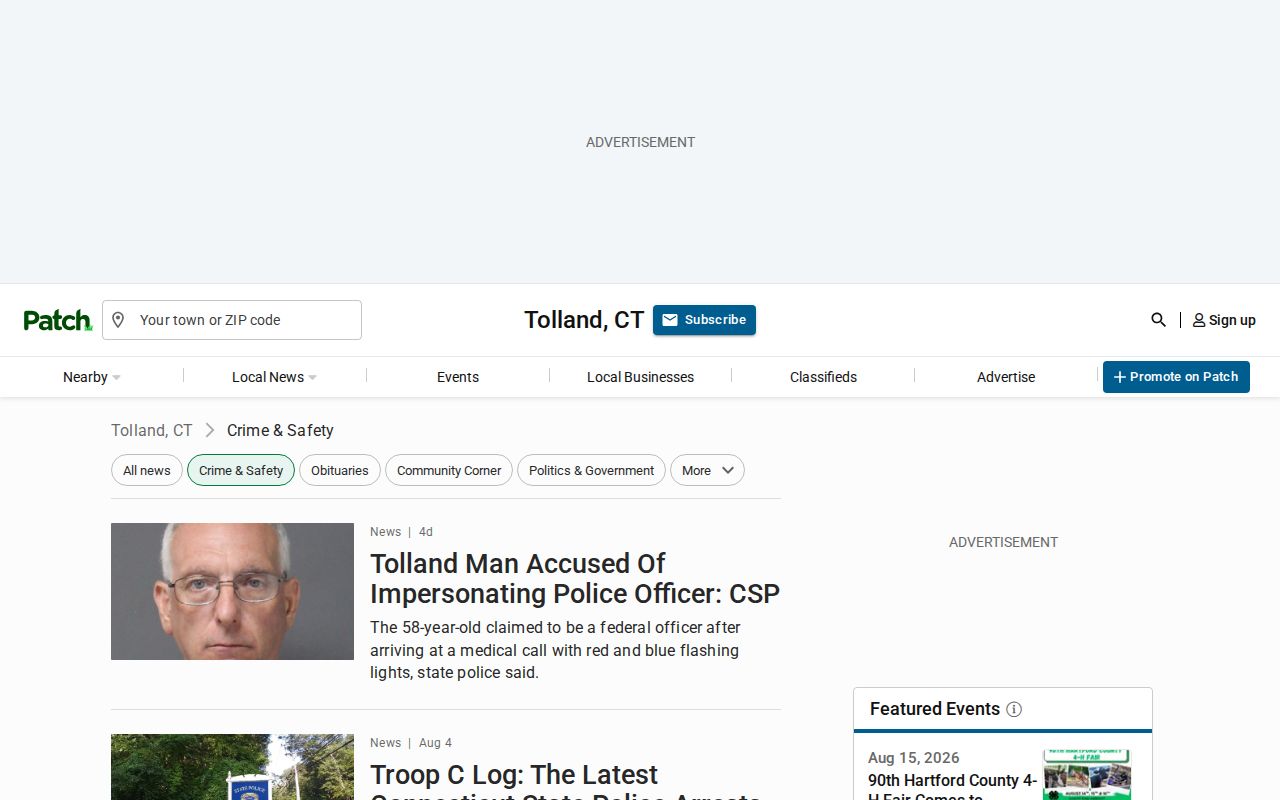
A news story can point you toward something worth a closer look. Custody facts, though, still come down to police paperwork and court files. Town-by-town coverage in Tolland County is uneven.
Vernon is the easy one. Official police releases sit alongside Patch Vernon and the Journal Inquirer. Mansfield demands more caution. UConn campus incidents run next to resident-trooper cases, and Patch Mansfield-Storrs works best as a backup source. Ellington never got a dedicated blotter, so Troop C's countywide roundups are the closest thing locals have to a regular feed. Knowing which town you're searching saves time.
Note: A roundup can omit routine arrests and can remain online after custody or court status has changed.
Tolland County Arrest Court Timing
News breaks fast. Paperwork does not. Connecticut's judicial branch calls for arraignment on the next court business day when a defendant is held in jail or faces a domestic-violence charge. The online Case Look-up trails behind, since it usually reflects entries finished by the close of the prior business day. Over a weekend, that gap can stretch for days. A fresh police report circulates while no matching docket exists yet online.
An empty search means little until the update cycle catches up. Check both the Pending Case and Daily Docket screens. If doubt lingers, call the clerk. Closed cases show their results through Convictions or the disclosable court file. Just note that online conviction data has retention limits, so an older outcome may live only with the clerk or the Superior Court Records Center.
Journalism and court records answer different questions. A story gives context and public statements. The police report names the initial charge. The final court disposition settles everything, whether conviction, dismissal, acquittal, or a nolle.
Historic Tolland Arrest Bulletins
Older DESPP notices reveal how enforcement used to be publicized. Troop C posted a DUI spotcheck on Route 195 in 2016. That same year, a holiday-enforcement notice cited an I-84 spot near Exit 68. In 2017, State Police released Memorial Day weekend details naming roving patrol corridors through Tolland-area towns.
Treat these as history, nothing more. They describe past publicity practice. They are not a current checkpoint schedule or a live booking feed. Dates matter, because search engines can rank an old government notice beside a fresh story even though the old one carries no operational value now. For current information, use the CSP News stream or contact the agency directly.
The same caution applies to local arrest news itself. Historic bulletins explain how public information once flowed. They should never be recast as a live warning. Today's arrests still follow the same chain: issuing agency, arrest record, court case, then disposition.